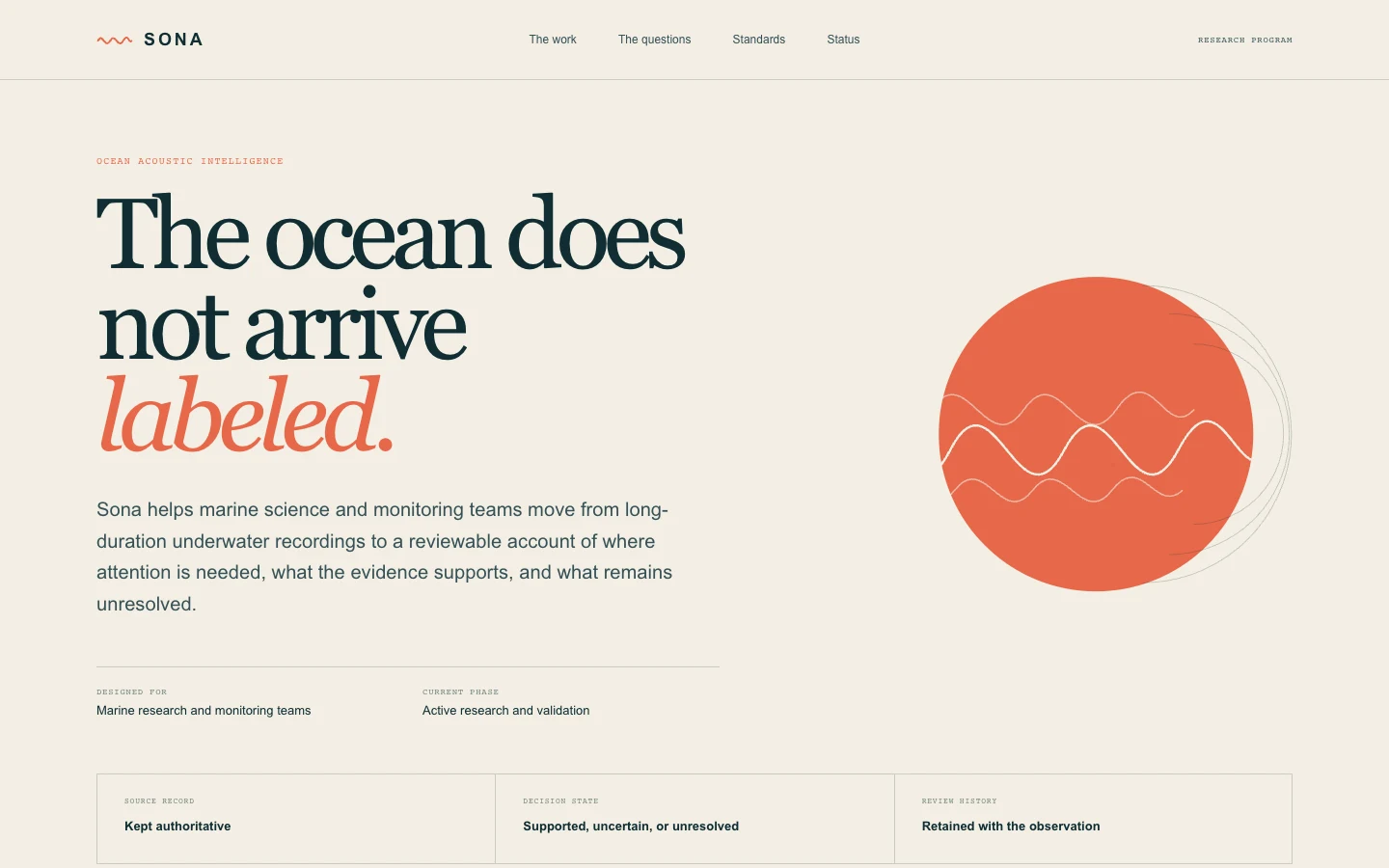
The source remains authoritative
Derived observations stay connected to the original recording and its capture context rather than replacing it.
Research program / ocean acoustics
A product and public technical system for moving from long duration underwater recordings to reviewable evidence without overstating what the signal can prove.
The premise
A hydrophone can collect months of material. The product problem is deciding where expert attention belongs while preserving enough context to revisit, challenge, or defend the decision later.
I framed Sona around a reviewable account rather than an automatic answer. Every public product statement starts from the source record, keeps uncertainty visible, and treats a human decision as part of the evidence history.
Product decisions
Sona is organized around three decisions that make the review model legible to scientists, operators, and product reviewers.
Derived observations stay connected to the original recording and its capture context rather than replacing it.
Supported, uncertain, and unresolved remain distinct outcomes. Abstention is available when the evidence does not support a narrower claim.
The observation carries its review history so later analysis can distinguish model output, source evidence, and expert judgment.
Public disclosure boundary
I implemented the public program surface as a separate static artifact built with semantic HTML and CSS. A small Node build copies only the approved site directory into the deployment artifact after an automated disclosure scan. It has no runtime connection to research infrastructure, private APIs, data, analytics, or internal evaluation results.
The site explains the user problem, observable review outcomes, scientific questions, and claim standard. The release gate flags private paths, secret material, long identifiers, precise coordinates, and numerical performance claims before build. Human review remains required for ordinary prose and scientific judgment.
Implementation evidence
A dependency free document keeps the public runtime small, inspectable, and isolated from research infrastructure.
The Node build emits only the reviewed site directory, so notes and research material cannot enter the deployment artifact by default.
An automated scan blocks several classes of accidental disclosure and explicitly leaves semantic review to a person.
Landmarks, a skip link, responsive layouts, readable contrast, and system color preferences support the shipped experience.
Current limits
Sona is under active validation. The public site is evidence of product framing, scientific communication, disclosure judgment, and a shipped web artifact. It is not evidence that a particular model, dataset, or scientific result has been validated.
No private architecture, data, evaluation values, customer claims, or internal performance results are presented here.